Today, we cover:
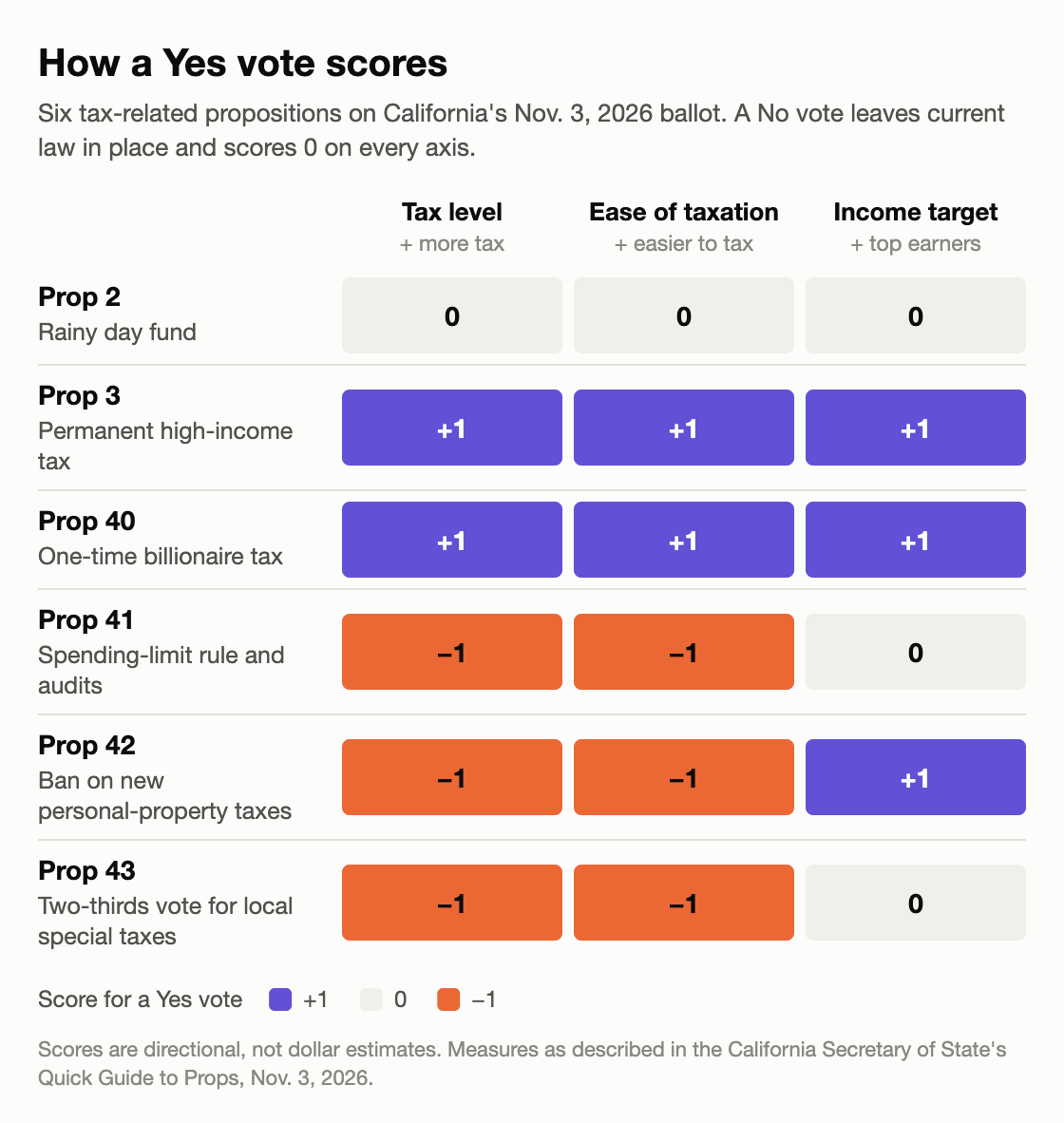
Each measure gets −1, 0 or +1 on three axes, scored for a Yes vote. Tax level is +1 if the measure raises a tax or keeps one that would otherwise expire, and −1 if it cuts a tax or restricts future ones. Ease of taxation is +1 if it makes taxes easier to impose or keep, and −1 if it makes them harder. Income target says who the measure is about: +1 for high-income or high-wealth taxpayers, −1 for lower-income households, 0 for no particular group. That axis describes the measure's subject. It doesn't say whether that group comes out ahead.
A No vote leaves current law in place, and current law is the baseline, so every No scores zero on all three axes. That holds for Prop 3 too, because current law already lets that tax expire in 2031.
The scores show direction only. They aren't dollar estimates, and the income axis is approximate by nature.
Prop 3 makes permanent an income-tax increase on individuals earning over $371,000, adjusted for inflation, that has been in place since 2012 and is set to expire in 2031. A Yes changes nothing on a 2027 tax return. What it changes is the decade after 2031, when the Legislative Analyst's Office estimates the state keeps $5 billion to $15 billion a year that it would otherwise lose. The revenue goes to schools and health care.
Prop 40 is a one-time tax of 5% on the wealth of taxpayers with assets over $1 billion, with the revenue going mainly to health care. The LAO expects a temporary gain of tens of billions of dollars, collected over several years. It also expects a possible ongoing loss of less than $1 billion a year in income tax, depending on how many billionaires leave the state. The revenue is exempt from the state's spending limit and from its school-funding formula. That exemption matters in the last section.
Both measures score +1 on every axis, because each one raises or keeps a tax that falls on the top of the income distribution. The difference is in timing: Prop 3's revenue recurs every year, and Prop 40's arrives once.
None of these changes a current tax rate. Each one changes the rules for the next tax.
Prop 41 has the State Auditor review the programs a proposed special tax would fund, both before the initiative reaches the ballot and on a regular schedule after it passes. It also nullifies any state tax enacted after January 1, 2026 whose revenue is exempt from the voter-approved spending limit. The LAO calls the net fiscal effect unknown, since it depends on what voters and the Legislature propose later.
Prop 42 bans new state taxes on owning personal property, meaning everything other than real estate, financial assets included. It also bans certain retroactive state taxes and nullifies any conflicting tax enacted after January 1, 2026. It cuts no existing tax. It scores +1 on income target because the people it protects are mostly those who hold large amounts of financial assets.
Prop 43 raises the vote needed for voter-proposed local special taxes from a simple majority to two-thirds, starting January 1, 2027. A library or fire tax that gets 60% of the vote passes under current rules and would fail under Prop 43. The LAO expects local tax revenue to grow more slowly as a result.
Prop 2 raises the cap on the state's rainy day fund from 10% to 20% of General Fund taxes, and it extends the state's required extra debt payments from 2030 through 2040. It neither raises nor lowers any tax. What it controls is how much of the money the state already collects gets spent this year and how much is saved for a downturn. That's why it scores zero across the grid. The trade-off is a steadier budget during a recession in exchange for less to spend in a good year.
The grid can't show this part. Prop 40's revenue is exempt from the spending limit, and Prop 41 nullifies taxes enacted after January 1, 2026 that carry that exemption. Prop 40 taxes wealth, financial assets included, and Prop 42 bans new taxes on owning personal property, financial assets included, with the same January 1, 2026 cutoff. Neither measure names Prop 40. But the cutoff date and the mechanism of each would apply to it, and Prop 42's opponents argue that undoing the billionaire tax is its real purpose.
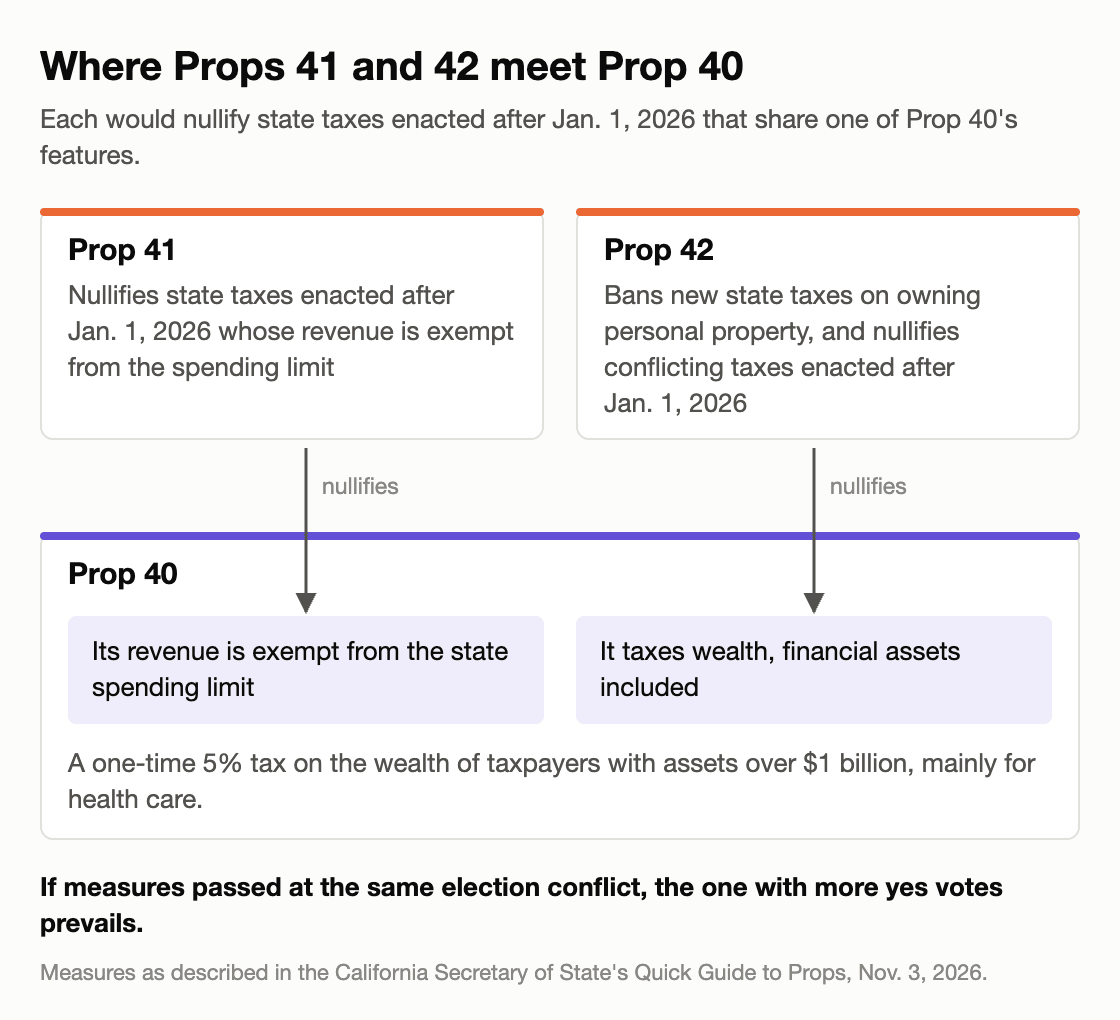
When measures passed at the same election conflict, the California Constitution gives effect to the one with more yes votes (Article XVIII, Section 4, for constitutional amendments like these). A Yes on 40 and a Yes on 42 are therefore not independent votes. If both pass, the result depends on the margins, and probably on a court.
Six measures are on the ballot, and three of them amount to a single argument.
Scores are directional and are not endorsements or legal advice. The official text and LAO analysis for each measure are in the Secretary of State's guide.